The best time to post reels: find yours from real data
Every blog publishes the same scheduling chart, and every chart is an average across millions of accounts. The timing that works for your account depends on your audience, your niche, and your format — and it is discoverable. SpyShrimp scores every post against the account’s median and shows how performance moves around posting gaps, so the pattern behind your breakouts stops being a guess.
Averages cannot tell you when your audience scrolls
“Post at 11am on weekdays” is an average. Averages hide the accounts that peak at 7am, the niches that spike on Sunday nights, and the fact that your best reel last month may have succeeded because of its hook, not its hour. Timing only becomes useful when you can compare posts against a baseline — that is the difference between a chart and an answer.
How SpyShrimp does it
Every post scored against the median
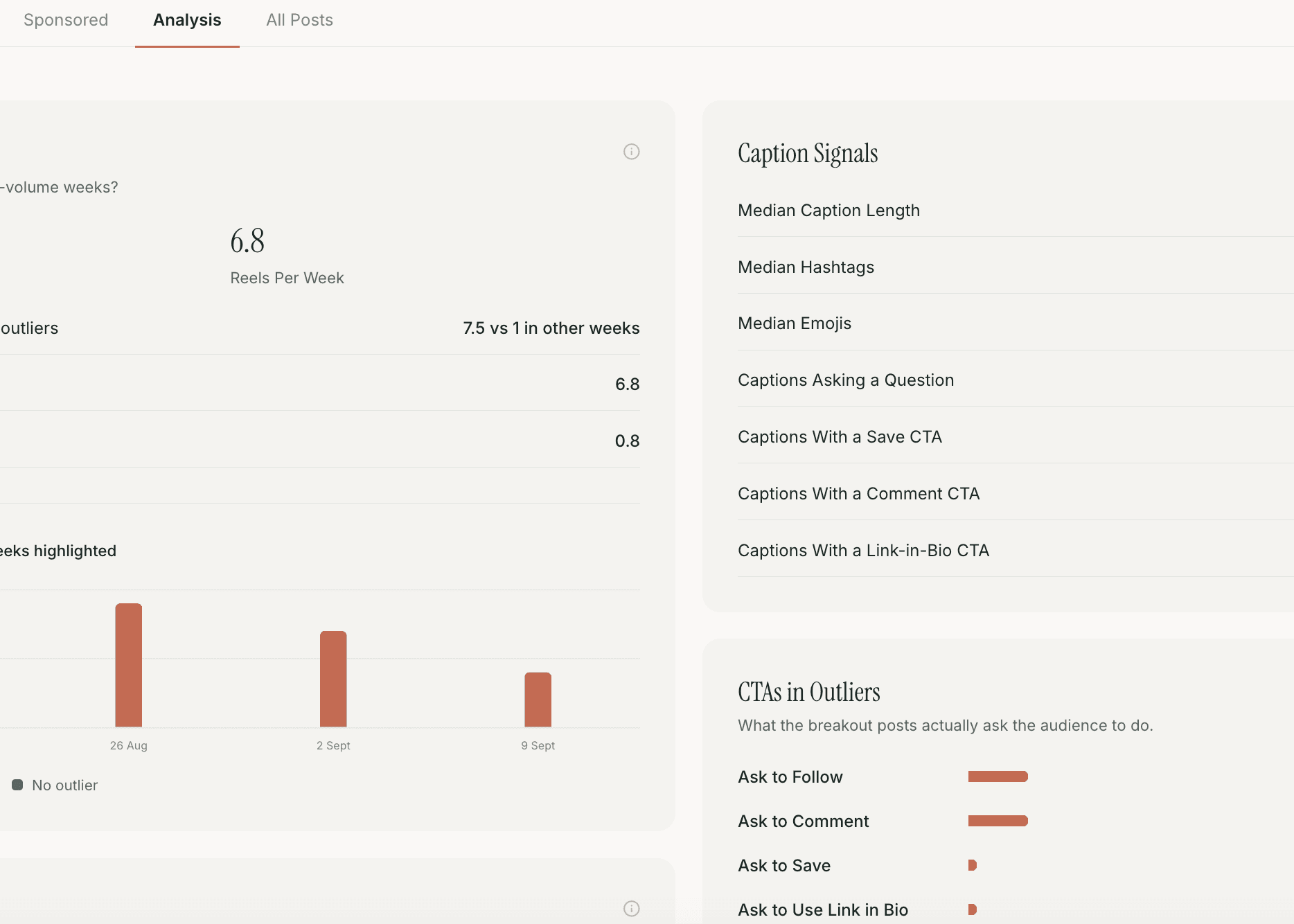
Cadence and posting-gap patterns
Benchmark against your niche
Timing gets the chance, content earns the watch
How it works
- 1
Search any public handle
Enter your own account — or a competitor’s, or the fastest-growing account in your niche. No connection, no login, and the account owner is never notified. - 2
Read the cadence pattern
In about three minutes: the account’s median, its outliers, and how performance moves around posting gaps. Compare the timing of the outliers against the days and hours they went up. - 3
Change one variable, re-audit
Adjust one thing — posting window or cadence — and re-run the analysis in a few weeks. Because every post is scored against the same baseline, the before-and-after comparison is honest.
Questions & answers
There is no single best time — the honest answer is that it depends on your audience, your niche, and your timezone. Calculated charts cluster around weekday mornings and evenings, but they are averages over millions of accounts, and averages are exactly what you should not optimize for. The reliable method is empirical: score every post against the account’s median, look at when the genuine breakouts went up, and compare that pattern against the fastest-growing accounts in your niche.
Content–audience fit does the heavy lifting; timing is the tiebreaker. A great reel posted at a mediocre hour still travels — the algorithm keeps distributing content that earns engagement. But when two posts are close in quality, the one dropped when your audience is already scrolling gets the faster start, and early engagement is what pushes a reel further. Treat timing as a second-order lever you can actually test, not a myth to ignore.
Four steps, about ten minutes: search your handle in SpyShrimp; note which posts beat your median (the outliers); check the day and hour those outliers were posted against the ones that under-performed; then compare the same pattern on two or three accounts growing fastest in your niche. Change one variable — a posting window or your cadence — and re-audit in a few weeks. Since every post is scored against the same median, you will see whether the change is real.
SpyShrimp shows how an account’s reach and engagement dip and recover around posting gaps, which is a more useful signal than any blanket rule. For most accounts, a sustainable, consistent cadence beats bursts followed by silence — but the right number is the one your niche rewards. Check the accounts winning your niche, compare their rhythm to yours, and adjust in one direction at a time.
Stop guessing when to post
See the cadence and timing patterns behind any public account’s breakouts — including your own. Start free with 3 searches, no credit card required.